Resistance-heating properties
Room-temperature resistivity Required by the standard
| Form and size band | ρ (20 °C) / μΩ·m |
|---|---|
| Wire, dia. 0.020–10.00 mm | 1.42 ± 0.07 |
| Strip, t 0.050–4.00 mm | 1.42 ± 0.07 |
Applies to soft (annealed) material only.
Unlike the nickel-chromium grades, the iron-chromium-aluminium grades are not size-banded — one value, 1.42 ± 0.07, covers every size, and the tolerance band (±0.07) is wider than the ±0.05 of the nickel-chromium grades.
At 1.42 the resistivity is about 25% above the 1.09-1.14 of Cr20Ni80: for the same element resistance the iron-chromium-aluminium alloy can use a thicker wire or a shorter run, which is its practical advantage in high-power furnaces.
⚠ Where wire (or strip) is accepted on ohms-per-metre, the room-temperature resistivity is not an acceptance item.
Resistance-temperature factor Informative only — not a basis for acceptance
| Temperature / °C | Factor k |
|---|---|
| 20 | 1.000 |
| 100 | 1.002 |
| 200 | 1.005 |
| 300 | 1.008 |
| 400 | 1.013 |
| 500 | 1.021 |
| 600 | 1.030 |
| 700 | 1.038 |
| 800 | 1.040 |
| 900 | 1.042 |
| 1000 | 1.044 |
| 1100 | 1.046 |
| 1200 | 1.047 |
| 1300 | 1.047 |
Multiply the 20 °C resistivity by this factor to obtain the resistivity at temperature.
The iron-chromium-aluminium curve rises monotonically and is essentially flat above 800 °C (1.040 to 1.047); the whole curve spans only 4.7%. Its shape is the opposite of Cr20Ni80's peak-at-500-°C-then-fall — two families with opposite trends in one table, so take care not to read across the wrong row.
A temperature factor is still given at 1300 °C (1.047), but it is informative and not a service-temperature commitment.
Rapid life test Required by the standard
| Test temperature | 1300 | °C |
| Rapid life, min. | 80 | h |
Tested to GB/T 13300, "Rapid life test for high-resistance heating alloys".
The iron-chromium-aluminium family is generally tested one step hotter than the nickel-chromium family (1300 °C for 0Cr25Al5 against 1200 °C for Cr20Ni80), for the same 80 h minimum.
⚠ 1300 °C is the test temperature, not a service temperature. In the same table 0Cr21Al6Nb and 0Cr27Al7Mo2 are tested hotter still (1350 °C) but for only 50 h — a higher test temperature does not mean a longer-lived alloy, and the two columns have to be read together.
No maximum service temperature is specified.
Ohms-per-metre uniformity Required by the standard
| Wire | Ohms-per-metre uniformity within any spool: ≤4% |
| Strip | Ohms-per-metre uniformity within any coil of cold-rolled strip: ≤5% |
Uniformity is calculated as RJY = 2(R1−R2)/(R1+R2) × 100%.
The supplier may waive or sample-check this where it can guarantee conformity, so per-spool measured data has to be written into the contract.
Recommended heat treatment Informative only — not a basis for acceptance
| Anneal | 750-850 °C, water quench |
This is a recommended heat treatment, not an acceptance requirement.
Applies to wire and strip over 2 mm in diameter or thickness; iron-chromium-aluminium alloys other than 0Cr27Al7Mo2 shall be quenched rapidly into water after heat treatment and shall not be cooled in air below 0 °C.
⚠ The rapid water quench matters in practice for iron-chromium-aluminium: slow cooling holds the material near 475 °C and embrittles it. 0Cr25Al5 falls inside the "other than 0Cr27Al7Mo2" scope, so the quench requirement applies to it.
Chemical composition
Nominal: mid-range where both limits are given, the cap where only a maximum is, balance takes the remainder. Exact specified ranges below.
| Element | Name | Content % | |
|---|---|---|---|
| Main elements3 elements | |||
| Fe | Iron | Bal. | |
| Cr | Chromium | 23 – 26% | |
| Al | Aluminium | 4.5 – 6.5% | |
| Element | Name | Content % | |
|---|---|---|---|
| Minor & residual6 elements | |||
| Ni | Nickel | ≤ 0.6% | |
| C | Carbon | ≤ 0.06% | |
| Mn | Manganese | ≤ 0.5% | |
| Si | Silicon | ≤ 0.6% | |
| P | Phosphorus | ≤ 0.025% | |
| S | Sulphur | ≤ 0.02% | |
Mechanical minima by form
Guaranteed values differ by form, size and delivery condition; quotations confirm the specification, form, size and condition.
| Form | Condition | Rm MPa | Rp0.2 MPa | A ≥ % | Other requirements and notes |
|---|---|---|---|---|---|
| Wire and filler metals | |||||
| Wire, dia. >3.00 mm | Annealed (soft) | ≥ 600 | — | ≥ 15 | |
| Wire, dia. 0.10–3.00 mm / FeCrAl strip over 0.200 mm thick | Annealed (soft) | ≥ 600 | — | ≥ 12 | |
| Wire | Rapid life test | — | — | — | Also specified: Rapid life ≥ 80 h @ 1300 °C |
| Several forms | |||||
| Wire and strip over 2 mm in diameter or thickness | Annealing recommended | — | — | — | Also specified: Heat treatment 750–850 °C, water quench |
Where this grade is recommended
Matched in 1 service conditions; ranks and scores computed from the condition-scoring matrix.
| Service condition | Industry | Temperature | Rank | Score |
|---|---|---|---|---|
| Heating elements & electrodes | Furnaces & Vacuum | 1000 – 1400 °C | 3 / 7 | 92 |
Designations & equivalents
| W.Nr. (Germany) | ≈ 1.4765 |
| EN designation | ≈ CrAl25 5 |
| Trade name(s) | Kanthal A-1 / Aluchrom / Resistohm / Nikrothal |
| GOST (Russia) | ≈ Х23Ю5Т |
Cross-references are common near-equivalents for search and shortlisting; substitution across standards requires clause-by-clause verification. All grades in one cross-reference table →
Applicable standards
Name the standard and its edition on the order.
Frequently asked questions
What is Fe-Cr-Al 0Cr25Al5 (Kanthal A-1 class)?
Fe-Cr-Al 0Cr25Al5 (Kanthal A-1 class) — Resistance heating alloys. Fe-Cr-Al elements to 1400 °C in air — high surface load, furnace wire and ribbon
What is the maximum service temperature of 0Cr25Al5?
Typically about 1400 °C; the practical limit depends on media, stress and design life — acceptance per the governing standard.
What is the tensile strength of 0Cr25Al5?
The specified minimum tensile strength is 600 MPa for the main product form. Minima for other forms and sizes are listed under "Mechanical minima by form" on this page.
Which standards cover 0Cr25Al5?
GB/T 1234—2012
Where is 0Cr25Al5 typically used?
Heating elements & electrodes (Furnaces & Vacuum)
In which forms is 0Cr25Al5 available?
Tube, plate, strip, bar, forgings, wire and other forms — sizes and delivery condition confirmed per order, with EN 10204 3.1 / 3.2 certification.
Same series
Download PDF datasheet
This grade’s datasheet as an A4 PDF — for filing, printing or forwarding to colleagues.
Download PDF datasheetSupply & enquiry
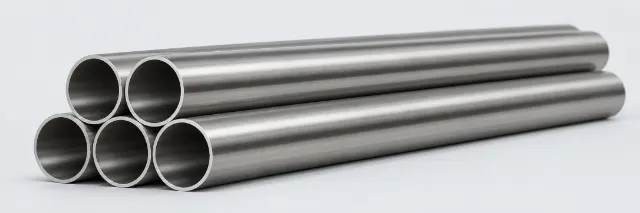 Tube & pipeφ1 – 219 × 0.25 – 25 mm
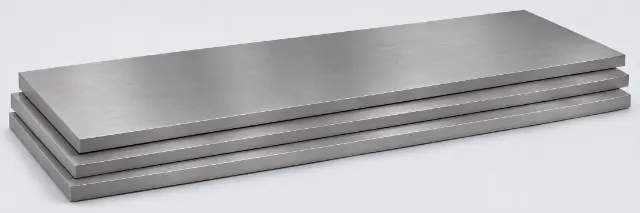 Plate4.76 – 80 mm
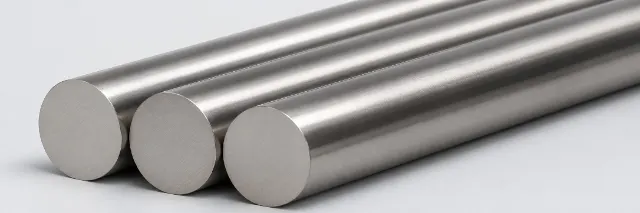 Barφ8 – 300 mm
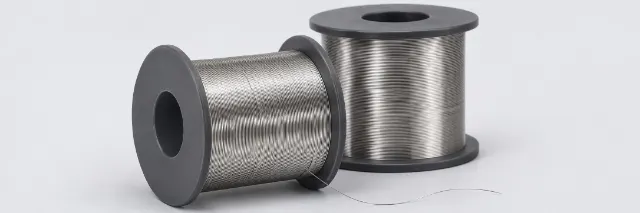 Wire & filler metalsφ0.01 – 8 mm
For this grade we can supply, against your service conditions:
- Tube, plate, strip, bar, forgings, wire and more — with size range and lead time
- Chemistry and mechanical test report (EN 10204 3.1 / 3.2)
- Like-for-like alternatives and selection advice
- Applicable standards and inspection scope
Or email us: info@kochlin.com