Recrystallisation & hot strength
Metallurgical condition as supplied Required by the standard
| Form | Available condition |
|---|---|
| Plate, sheet, strip and foil | Annealed (default) |
| Plate, sheet, strip and foil, when so ordered | Fully recrystallised: 90% minimum recrystallised |
| Cold-worked or stress-relieved | By agreement between purchaser and manufacturer at the time of purchase |
All material is supplied annealed unless the purchaser specifies otherwise.
Where the order specifies the "fully recrystallized" condition, plate, sheet, strip and foil must be at least 90 % recrystallised; "fully annealed", "completely" and similar terms mean the same.
⚠ Refractory metals rarely have recrystallisation as a quantified acceptance criterion — 90 % is a measurable, judgeable number rather than an adjective. To invoke it the order has to say "fully recrystallized"; asking only for "annealed" does not buy the 90 %.
⚠ It is the exact opposite of molybdenum, where recrystallisation is the failure mode to be resisted and material is supplied stress-relieved by default; for tantalum it is the delivery condition to be achieved. Two refractory metals, opposite requirements.
Protective annealing atmosphere Informative only — not a basis for acceptance
Not permitted — This specification does not prescribe a protective annealing atmosphere.
Unlike molybdenum, tantalum has no annealing-atmosphere purity requirement. That is not because atmosphere does not matter to tantalum — above about 300 °C it takes up oxygen, nitrogen and hydrogen readily, and hydrogen pickup embrittles it badly — but because the process is left to the manufacturer and checked through the interstitial limits on the finished product (O, N, H, C).
In practice tantalum has to be annealed in high vacuum or high-purity inert gas, and the check is whether the finished product's O, N and H are still inside the finished-product limits, not what the furnace is nominally flowing.
Chemical composition
Nominal: elements given only as a maximum are counted at the cap; the balance takes the remainder.
| Element | Name | Content % | |
|---|---|---|---|
| Main elements1 element | |||
| Ta | Tantalum | Bal. | |
| Element | Name | Content % | |
|---|---|---|---|
| Minor & residual11 elements | |||
| O | Oxygen | ≤ 0.015% | |
| C | Carbon | ≤ 0.01% | |
| N | Nitrogen | ≤ 0.01% | |
| H | Hydrogen | ≤ 0.0015% | |
| Nb | Niobium | ≤ 0.1% | |
| W | Tungsten | ≤ 0.05% | |
| Mo | Molybdenum | ≤ 0.02% | |
| Fe | Iron | ≤ 0.01% | |
| Ti | Titanium | ≤ 0.01% | |
| Ni | Nickel | ≤ 0.01% | |
| Si | Silicon | ≤ 0.005% | |
Mechanical minima by form
Guaranteed values differ by form, size and delivery condition; quotations confirm the specification, form, size and condition.
| Form | Condition | Rm MPa | Rp0.2 MPa | A ≥ % |
|---|---|---|---|---|
| Bar and forgings | ||||
| Bar | Annealed, dia. 3.18–63.5 mm | ≥ 172 (25 ksi) | ≥ 103 (15 ksi) | ≥ 25 |
| Plate, sheet and strip | ||||
| Plate, sheet and strip | Annealed, t <1.52 mm (0.060 in) | ≥ 207 (30 ksi) | ≥ 138 (20 ksi) | ≥ 20 |
| Plate, sheet and strip | Annealed, t ≥1.52 mm (0.060 in) | ≥ 172 (25 ksi) | ≥ 103 (15 ksi) | ≥ 30 |
| Wire and filler metals | ||||
| Wire | Annealed, dia. 0.254–0.379 mm | ≥ 241 (35 ksi) | — | ≥ 10 |
| Wire | Annealed, dia. 0.381–0.633 mm | ≥ 241 (35 ksi) | — | ≥ 15 |
| Wire | Annealed, dia. 0.635–3.14 mm | ≥ 207 (30 ksi) | — | ≥ 20 |
Hardness requirement
Required by the standard, conditionally — < 100 HV0.2/30 (annealed plate and strip)
A maximum, not a minimum.
More detail 4
When the purchaser requires it and states so in the contract, annealed Ta1 and Ta2 plate and strip shall have a Vickers hardness below 100 HV0.2/30.
Annealed tantalum is meant to be soft — its value lies in deep drawing and explosion cladding, and hard material will not form; a high reading usually means insufficient annealing or oxygen pickup.
Note that the load and dwell are part of the designation: HV0.2 is a 0.2 kgf load and /30 a 30 s dwell, so readings taken at another load are not comparable.
This is an optional purchase item, not a per-lot test.
Grain size
Required by the standard, conditionally — Mean grain size No. 5 or finer (recrystallisation-annealed)
⚠ A direction trap.
More detail 5
The requirement is "not less than No. 5" — a higher ASTM grain-size number means finer grain, so this means No. 5 or finer.
For comparison, 800H requires "No. 5 or coarser": the same number 5, but the opposite half of the axis.
Tantalum wants fine grain so that deep drawing does not raise orange peel or coarse-grain bands; 800H wants coarse grain for creep life.
Read the direction — "or finer" against "or coarser" — before reading the number.
This is an optional purchase item, applied only when the purchaser requires it and states so in the contract.
Where this grade is recommended
Matched in 22 service conditions; ranks and scores computed from the condition-scoring matrix.
| Service condition | Industry | Temperature | Rank | Score |
|---|---|---|---|---|
| Sputtering targets | Semiconductor & Vac-Electronics | Ambient | 1 / 6 | 93 |
| HCl & reducing acids | Chemical Processing | ≤ 60 °C | 4 / 8 | 92 |
| Crucibles & moulds | Furnaces & Vacuum | 1000 – 1500 °C | 1 / 5 | 90 |
| Coating equipment & targets | Solar & Glass | ≤ 600 °C | 1 / 4 | 90 |
| Imaging equipment & targets | Medical Devices | In-body (37 °C) | 2 / 5 | 90 |
| Orthopaedic & dental implants | Medical Devices | High-temperature processing | 3 / 8 | 90 |
| Wet Cl₂, chlor-alkali | Chemical Processing | ≤ 80 °C | 7 / 11 | 90 |
| Stents & cardiovascular | Medical Devices | In-body (37 °C) | 2 / 4 | 88 |
| HT boats & fixtures | Semiconductor & Vac-Electronics | 800 – 1200 °C | 5 / 5 | 88 |
| Fuel-cell bipolar plates | Automotive & Racing | 90 – 180 °C | 3 / 4 | 87 |
| Dental restoration | Medical Devices | High-temperature processing | 2 / 4 | 86 |
| Vacuum electronics | Semiconductor & Vac-Electronics | 400 – 900 °C | 3 / 8 | 86 |
Top 12 by score shown; 10 more matched conditions — browse them by industry in the selector. Open the selector →
Designations & equivalents
| UNS | R05200 |
| Trade name(s) | Tantalum / Ta1 |
| ASTM / AISI | B365 / B521 / B708 |
Cross-references are common near-equivalents for search and shortlisting; substitution across standards requires clause-by-clause verification. All grades in one cross-reference table →
Applicable standards
3 specifications. Name the standard and its edition on the order.
Guaranteed values and required tests differ between specifications — see Mechanical minima by form for the figures per form.
Frequently asked questions
What is Pure Tantalum Ta1?
Pure Tantalum Ta1 — Tantalum / Niobium. The ultimate answer for hot concentrated hydrochloric and sulphuric acid
What is the maximum service temperature of Ta1?
Typically about 250 °C; the practical limit depends on media, stress and design life — acceptance per the governing standard.
What is the tensile strength of Ta1?
The specified minimum tensile strength is 207 MPa for the main product form. Minima for other forms and sizes are listed under "Mechanical minima by form" on this page.
Which standards cover Ta1?
ASTM B708-25, ASTM B365-12, ASTM B521
Where is Ta1 typically used?
Sputtering targets (Semiconductor & Vac-Electronics); HCl & reducing acids (Chemical Processing); Crucibles & moulds (Furnaces & Vacuum); Coating equipment & targets (Solar & Glass)
In which forms is Ta1 available?
Tube, plate, strip, bar, forgings, wire and other forms — sizes and delivery condition confirmed per order, with EN 10204 3.1 / 3.2 certification.
Same series
Download PDF datasheet
This grade’s datasheet as an A4 PDF — for filing, printing or forwarding to colleagues.
Download PDF datasheetSupply & enquiry
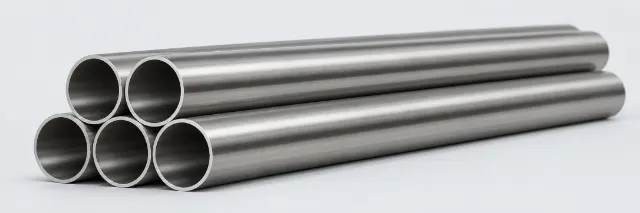 Tube & pipeφ1 – 219 × 0.25 – 25 mm
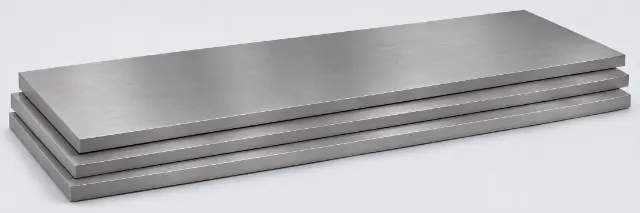 Plate4.76 – 80 mm
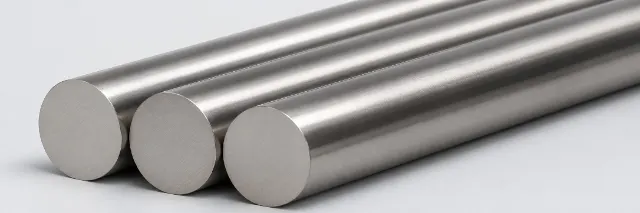 Barφ8 – 300 mm
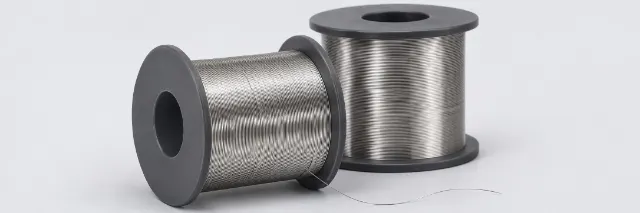 Wire & filler metalsφ0.01 – 8 mm
For this grade we can supply, against your service conditions:
- Tube, plate, strip, bar, forgings, wire and more — with size range and lead time
- Chemistry and mechanical test report (EN 10204 3.1 / 3.2)
- Like-for-like alternatives and selection advice
- Applicable standards and inspection scope
Or email us: info@kochlin.com