Recrystallisation & hot strength
Metallurgical condition as supplied Required by the standard
| Form | Available condition |
|---|---|
| Bar, rod and wire | Wrought and stress relieved (SR) |
| Bar and rod, when so ordered | Essentially fully recrystallised (RX) |
Unless the purchase order states otherwise, products are supplied wrought and stress relieved (SR). RX has to be called out.
The two tempers: SR = stress-relieved, RX = essentially fully recrystallized. Each carries its own set of minima, and the two sets must not be mixed.
Stress-relieved versus recrystallised Required by the standard
| Temper and size band | Rm ≥ / MPa | Rp0.2 ≥ / MPa | A ≥ / % |
|---|---|---|---|
| Stress-relieved (SR), dia. 28.6-47.6 mm | 515 | 450 | 10 |
| Recrystallised (RX), dia. <50.8 mm | 415 | 240 | 20 |
Recrystallisation costs pure molybdenum strength, which is why each temper has its own set of minima. On recrystallisation the specified yield strength falls from 450 to 240 MPa (about −47%) and the tensile from 515 to 415 (about −19%), while elongation rises from 10% to 20%. The hardness limit likewise changes from a 210-260 DPH band to 200 max.
⚠ The two diameter bands do not line up exactly: the SR row is 1.125-1.875 in (28.6-47.6 mm), the RX row is under 2 in (<50.8 mm). That is how the standard bands them, not something assembled here; read the pair as the same size class, not as before-and-after measurements on one bar.
The engineering consequence: once a molybdenum part is taken above its recrystallisation temperature in service, strength drops by roughly this much and does not come back. The design temperature has to sit below the recrystallisation temperature, not below the melting point.
Thermal-stability reheat test Required by the standard, conditionally
| Material | Reheat temperature |
|---|---|
| Material 360 (VAR pure molybdenum) | 900 °C (1650 °F) |
| Material 361 (P/M pure molybdenum) | 900 °C (1650 °F) |
| Both of the above, rounds ≤47.6 mm dia. | 850 °C (1550 °F) |
| Hold time | 30 min |
If the purchase order specifies it, the material must still meet the tensile minima after reheating in a protective atmosphere to the specified temperature for 30 min.
⚠ This is done only when the purchase order specifies it, which is why the basis is recorded as conditional. If you want the guarantee you have to write it into the order; otherwise the mill does not run the test and the certificate will not carry it.
The criterion is not "does not recrystallise" but "still meets the tensile minima after 30 min of reheating" — an acceptance test for recrystallisation resistance, which is harder evidence than a bare recrystallisation temperature.
For 360, 361 and 365 rounds 1.875 in (47.6 mm) diameter and below, the annealing temperature is 1550 °F (850 °C) — a lower temperature for the smaller sizes, which carry more prior deformation and recrystallise more readily.
Protective annealing atmosphere Required by the standard
| Acceptable atmosphere | Purity threshold |
|---|---|
| Hydrogen | Dew point ≤0 °C |
| Argon | Oxygen ≤5 ppm |
| Helium | Oxygen ≤5 ppm |
| Vacuum | Pressure ≤0.0133 Pa |
Not permitted — Nitrogen is not an acceptable atmosphere for annealing molybdenum or molybdenum alloys.
⚠ The outright prohibition on nitrogen is unusual for an ASTM specification and worth listing on its own: at temperature, nitrogen forms nitrides with molybdenum and embrittles the surface. Many shops treat nitrogen as a general-purpose cheap inert gas; on molybdenum that is simply wrong.
All four acceptable atmospheres carry a purity threshold — argon and helium at the 5 ppm oxygen level, vacuum down to 0.0133 Pa. A protective atmosphere that misses its purity spec is not protective.
Chemical composition
Nominal: elements given only as a maximum are counted at the cap; the balance takes the remainder.
| Element | Name | Content % | |
|---|---|---|---|
| Main elements1 element | |||
| Mo | Molybdenum | Bal. | |
| Element | Name | Content % | |
|---|---|---|---|
| Minor & residual6 elements | |||
| C | Carbon | ≤ 0.01% | |
| O | Oxygen | ≤ 0.007% | |
| N | Nitrogen | ≤ 0.002% | |
| Fe | Iron | ≤ 0.01% | |
| Ni | Nickel | ≤ 0.005% | |
| Si | Silicon | ≤ 0.01% | |
Mechanical minima by form
Guaranteed values differ by form, size and delivery condition; quotations confirm the specification, form, size and condition.
| Form | Condition | Rm MPa | Rp0.2 MPa | A ≥ % |
|---|---|---|---|---|
| Round bar and rod | Stress-relieved (SR), dia. 0.51–3.18 mm | ≥ 585 (85 ksi) | ≥ 450 (65 ksi) | ≥ 15 |
| Round bar and rod | Stress-relieved (SR), dia. >3.18–10.32 mm | ≥ 515 (75 ksi) | ≥ 380 (55 ksi) | ≥ 15 |
| Round bar and rod | Stress-relieved (SR), dia. >10.32–22.2 mm | ≥ 620 (90 ksi) | ≥ 515 (75 ksi) | ≥ 18 |
| Round bar and rod | Stress-relieved (SR), dia. >22.2–28.6 mm | ≥ 585 (85 ksi) | ≥ 480 (70 ksi) | ≥ 15 |
| Round bar and rod | Stress-relieved (SR), dia. >28.6–47.6 mm | ≥ 515 (75 ksi) | ≥ 450 (65 ksi) | ≥ 10 |
| Round bar and rod | Stress-relieved (SR), dia. >47.6–73.0 mm | ≥ 480 (70 ksi) | ≥ 415 (60 ksi) | ≥ 10 |
| Round bar and rod | Stress-relieved (SR), dia. >73.0–88.9 mm | ≥ 450 (65 ksi) | ≥ 380 (55 ksi) | ≥ 10 |
| Round bar and rod | Stress-relieved (SR), dia. >88.9–165 mm | ≥ 450 (65 ksi) | ≥ 380 (55 ksi) | ≥ 5 |
| Round bar and rod | Substantially fully recrystallised (RX), dia. <50.8 mm | ≥ 415 (60 ksi) | ≥ 240 (35 ksi) | ≥ 20 |
| Round bar and rod | Substantially fully recrystallised (RX), dia. 50.8–165 mm | ≥ 380 (55 ksi) | ≥ 170 (25 ksi) | ≥ 20 |
Where this grade is recommended
Matched in 16 service conditions; ranks and scores computed from the condition-scoring matrix.
| Service condition | Industry | Temperature | Rank | Score |
|---|---|---|---|---|
| Glass melting electrodes | Solar & Glass | 1200 – 1600 °C | 1 / 4 | 95 |
| HT boats & fixtures | Semiconductor & Vac-Electronics | 800 – 1200 °C | 1 / 5 | 94 |
| CZ hot zone (Si) | Solar & Glass | 1400 – 1600 °C | 1 / 4 | 94 |
| Sintering boats & setters | Furnaces & Vacuum | 1000 – 1350 °C | 1 / 5 | 93 |
| Heat shields & reflectors | Furnaces & Vacuum | 1000 – 1400 °C | 1 / 5 | 92 |
| Heaters & susceptors | Semiconductor & Vac-Electronics | ≤ 500 °C | 1 / 4 | 92 |
| Heating elements & electrodes | Furnaces & Vacuum | 1000 – 1400 °C | 2 / 7 | 92 |
| Vacuum electronics | Semiconductor & Vac-Electronics | 400 – 900 °C | 1 / 8 | 90 |
| Coating equipment & targets | Solar & Glass | 600 – 1200 °C | 1 / 4 | 90 |
| Crucibles & moulds | Furnaces & Vacuum | 1000 – 1500 °C | 2 / 5 | 90 |
| Vacuum hot zone & hot dies | Furnaces & Vacuum | 1000 – 1400 °C | 3 / 6 | 90 |
| Sputtering targets | Semiconductor & Vac-Electronics | Ambient | 3 / 6 | 90 |
Top 12 by score shown; 4 more matched conditions — browse them by industry in the selector. Open the selector →
Designations & equivalents
| Trade name(s) | Pure Molybdenum Mo1 |
| ASTM / AISI | ASTM B387 |
| GOST (Russia) | ≈ МЧ |
Cross-references are common near-equivalents for search and shortlisting; substitution across standards requires clause-by-clause verification. All grades in one cross-reference table →
Applicable standards
Name the standard and its edition on the order.
Frequently asked questions
What is Pure Molybdenum Mo1?
Pure Molybdenum Mo1 — Molybdenum. Pure molybdenum — vacuum furnace parts, electrodes and boats
What is the maximum service temperature of Mo1?
Typically about 1100 °C; the practical limit depends on media, stress and design life — acceptance per the governing standard.
What is the tensile strength of Mo1?
The specified minimum tensile strength is 620 MPa for the main product form. Minima for other forms and sizes are listed under "Mechanical minima by form" on this page.
Which standards cover Mo1?
ASTM B387/B387M-23
Where is Mo1 typically used?
Glass melting electrodes (Solar & Glass); HT boats & fixtures (Semiconductor & Vac-Electronics); CZ hot zone (Si) (Solar & Glass); Sintering boats & setters (Furnaces & Vacuum)
In which forms is Mo1 available?
Tube, plate, strip, bar, forgings, wire and other forms — sizes and delivery condition confirmed per order, with EN 10204 3.1 / 3.2 certification.
Same series
Download PDF datasheet
This grade’s datasheet as an A4 PDF — for filing, printing or forwarding to colleagues.
Download PDF datasheetSupply & enquiry
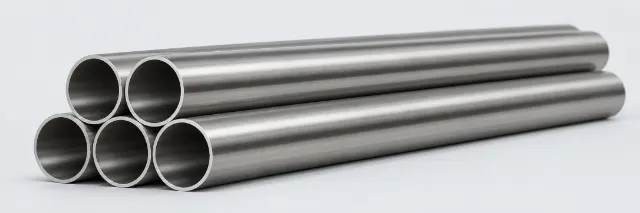 Tube & pipeφ1 – 219 × 0.25 – 25 mm
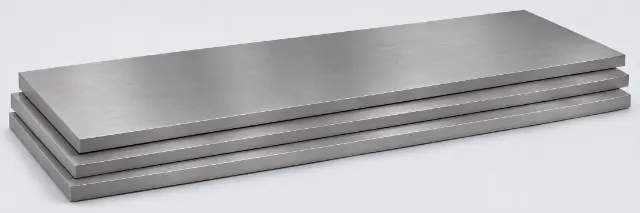 Plate4.76 – 80 mm
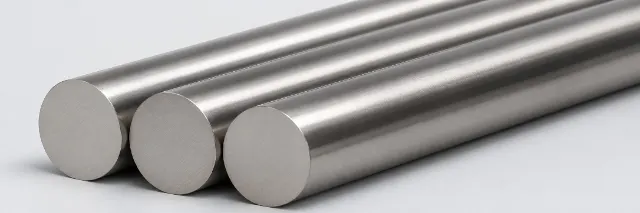 Barφ8 – 300 mm
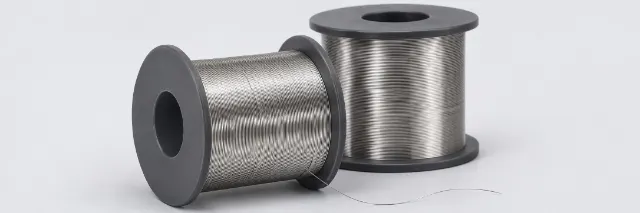 Wire & filler metalsφ0.01 – 8 mm
For this grade we can supply, against your service conditions:
- Tube, plate, strip, bar, forgings, wire and more — with size range and lead time
- Chemistry and mechanical test report (EN 10204 3.1 / 3.2)
- Like-for-like alternatives and selection advice
- Applicable standards and inspection scope
Or email us: info@kochlin.com